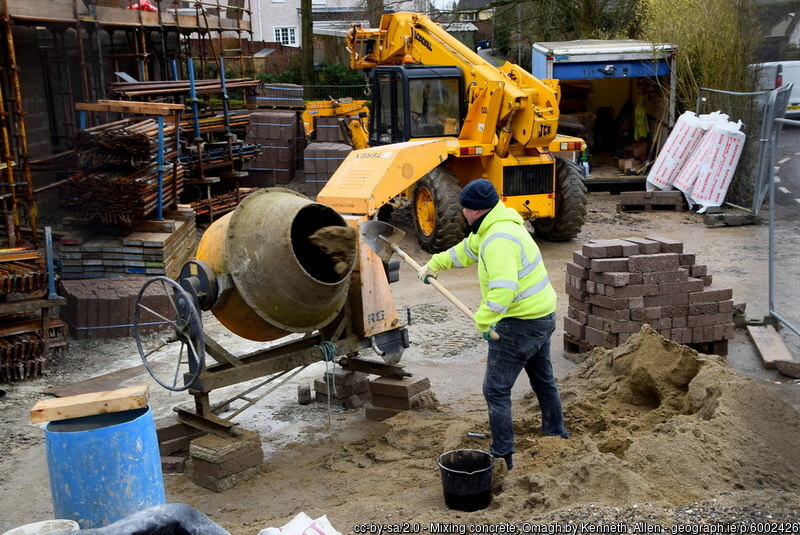
The right materials for concrete mixing
Concrete is a mixture of portland cement, coarse aggregate (crushed stone and gravel), and fine aggregate (sand). Concrete is also one of the cheapest building materials and is very durable. The mixture between the materials has to be carefully measured and there are certain ratios between the materials that you must keep. The ratio between the materials is usually represented by three numbers (1:4:3), meaning 1 part cement, 4 parts sand, and 3 parts gravel.

Portland cement
Portland cement is a manufactured product made finer than flour. Usually, the cement is a gray color, but you can buy other colors for different uses such as flower pots, lawn ornaments, and other decorative uses. The quality of the cement can be assured by the approval of the ASTM (American Society for Testing and Materials) printed on the cement bag. When you are combining the cement with water it makes a cement paste and makes about 25-40 percent of the total concrete mixture.
Coarse aggregate is usually either gravel or crushed stone. It is about ¼ inch to about 1½ inch wide. You can order gravel by either size or bank run (gravel with several sizes mixed in along with sand). The material has to be clean, hard, and free of any organic matter like algae or manure. Aggregates make up about 60-70 percent of the concrete mixture.
Fine aggregates
Fine aggregate is sand that should be free of any foreign matter when used in concrete mixing. The sand should be able to pass through a ¼ inch screen. If you are using non-commercial sand then test it for silt content. You can do this by putting 2 inches of sand in a quart jar and adding water until the jar is about three-quarters full. Mix and shake the jar quickly for a minute and then let sit for an hour. If you see a silt layer at the top more than 3/16 inch thick then it is unusable. Vegetable matter or clay in the sand will ruin the bonding between the cement paste and the sand. Mortar sand is also unusable for concrete because the particles are too small. Do not use seashore sand for a concrete mix.
Information sponsored by M3 Industries of St. George, UT.