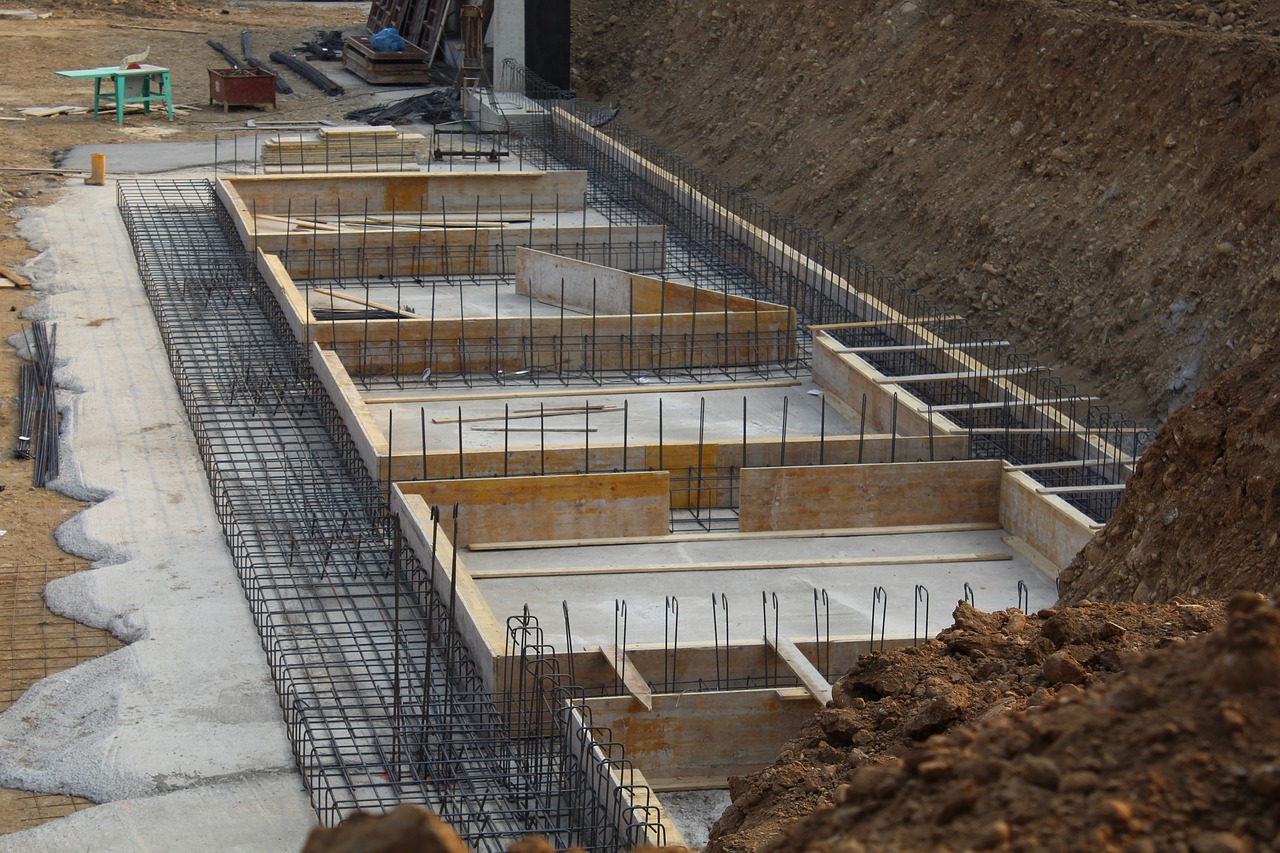
Footings must always lay on soil that hasn’t been disturbed below the frost line. Place the footings on top of slightly dampened soil, make sure the soil isn’t wet. The varying depths that footings must go below grade is specified by agencies of the federal government and will change with factors such as being in an earthquake zone, soil conditions, depth of frost penetration, local building custom, and experience. Make sure to check your local building code for reference because it can differ from national requirements. While concrete foundations in Maine must be only 4½ below grade, Florida for example has to build footings 6 inches below grade.

In colder climates, crowned bed slabs may be used for outbuildings. The slab can be laid over a thick bed of gravel. Heaving caused by frost raises an entire structure as a unit.
There are three main types of concrete footings: circular column piers, keyed footings, and flat-top footings. The keyed footings can be made by pouring a normal footing with a wooden 2×4 across the top. A normal flat-top footing is used for concrete walls or when the entire wall is poured.
Circular concrete piers are used as both footing and concrete foundation support if they have a sufficient diameter of around one foot. They are usually spaced around the perimeter of the structure and under any interior construction as building codes specify. Post holes can be dug to hold laminated fiber and fill the forms with concrete.
Determining the front line is the first step for getting building lines for concrete foundations. The front line is the outer face of the foundation wall for a structure. You can find this line by carefully measuring from an existing property line or structure. To mark the line, use two temporary stakes driven into the ground. You can then check the plan and locate one of the outside corners of the front foundation wall. Drive a stake to mark the corner, then drive a nail into the top of the stake.
You can then measure along the temporary front line to the spot where the other corner should be. Drive another stake in that spot and put a nail in the top. The exact front line of the foundation is the line between the two nails. Stretch a line between the two front corner stakes and set up the other three sides in the same way.
Make sure to check the measurements after the building lines are laid out. For a square or rectangle, opposite sides will always have the same lengths and the diagonals will be equal. Corners will be located where lines for outside surfaces intersect. To make sure all of the corners are 90 degrees, measure 3 feet in one direction, and 4 feet at the right angle. After that, the diagonal should be 5 feet. You can also use a large builder’s square.
Information sponsored by M3 Industries of St. George, UT.